After decades confined to research labs and science fiction, humanoid robots are moving decisively into commercial deployment.
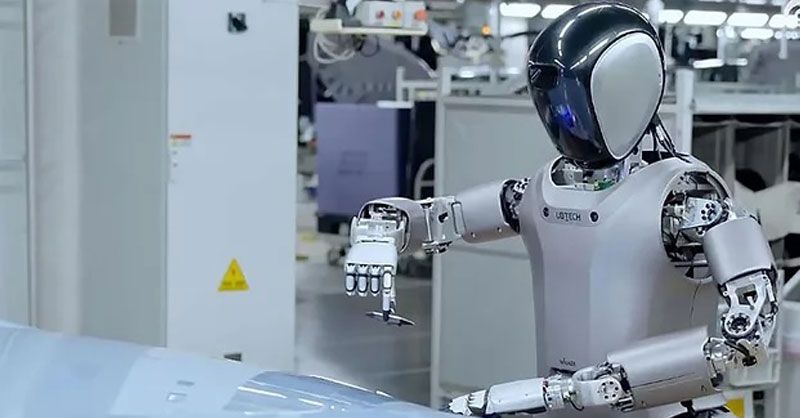 This goes beyond gradual progress; it represents a structural shift from rigid, task-specific automation toward adaptable, embodied AI systems designed to operate seamlessly in human environments.
Labor Shortages Create Immediate Demand
The urgency for implementing humanoid robots is being driven by hard economic realities economy-wide. For example, the manufacturing sector currently faces 380,000 unfilled positions, double its 20-year historical average¹. This persistent labor gap, which continues despite challenging market conditions, is accelerating automation adoption. Morten Paulsen, ROBO Global Strategic Advisor and Head of Research and Managing Director at CLSA Japan, suggests that the deficit is structural rather than cyclical. Manufacturers are increasingly prioritizing solutions that integrate into existing facilities without requiring costly redesigns - a dynamic that potentially favors humanoid robotics.
Three Breakthroughs Reshaping Commercial Viability
Several technological advances are now converging to unlock large-scale deployment of more human-like robotics solutions.
Tactile Dexterity
Tactile dexterity represents a major leap forward from the last generation of robotics. New vision-based touch sensors, like those in the fingertips of Tesla's Optimus, allow robots to "feel" pressure and texture, enabling them to manipulate fragile objects like eggs or glass without crushing them. This capability unlocks applications previously impossible for rigid automation systems.
Industrial Endurance
Industrial endurance has improved dramatically through breakthroughs in actuator efficiency and hot-swappable battery systems. These advances allow robot fleets to operate continuously, solving the downtime issues that previously stalled commercial pilots.
Expansion of Consumer Markets
Perhaps most significantly, the consumer robotics market is awakening. After being confined to limited saucer-style vacuum cleaners for decades, the consumer market is opening entirely fresh and enormous addressable markets that will create a rising-tide effect for the entire industry.
Commercial Deployments Accelerate
Companies within the ROBO Global Robotics & Automation Index ETF (ROBO) are already driving real-world implementation. Tesla is integrating its Optimus humanoid into gigafactories to automate repetitive labor, with a targeted production cost lower than that of a standard car.
UBTECH Robotics has deployed its Walker S humanoid across BYD and Geely automotive plants, where robots perform precision tasks including seatbelt inspection and logo installation on active assembly lines.
NVIDIA, another holding the ROBO ETF, is providing the industry-standard "Robot Brain" with Isaac Sim, Project GR00T, and Jetson Thor computers. These platforms enable manufacturers like Foxconn and Agility Robotics to train humanoids in simulation before deploying them to the real world, dramatically reducing development costs and time-to-deployment.
Three High-Value Use Cases
Hazardous Environment Operations
Humanoids can perform maintenance in zones involving extreme heat, toxic exposure, or radiation, utilizing standard human tools and interfaces while reducing worker risk.
Brownfield Factory Automation
Older factories were designed for human workers. Humanoids share the same footprint and reach, allowing automation without dismantling existing infrastructure - a substantial cost advantage over traditional robotics deployments.
Emerging Consumer & Care Markets
Humanoid systems are beginning to enter homes and elder-care settings, addressing the needs of aging populations. These markets represent entirely new growth vectors.
The Investment Perspective
Henrik Christensen, PhD, ROBO Global Strategic Advisor and Professor at UC San Diego and Director of the Contextual Robotics Institute, has noted:
“Physical AI and automation are going to be a bigger part of GDP than what's happening in just the digital realm.”
The convergence of improved hardware, increasingly capable AI models, and persistent labor shortages is creating a clear inflection point for humanoid robots. Importantly, value creation is not limited to robot manufacturers. Companies providing enabling technologies including vision systems, actuators, simulation platforms, AI compute infrastructure currently sit at the foundation of this transformation.
For investors seeking exposure to this trend, the ROBO Global Robotics & Automation Index ETF (ROBO) seeks to provide diversified access to companies across the entire robotics value chain, from component suppliers to system integrators to end-use deployers.
The shift from concept to commercial deployment suggests the market opportunity is moving from theoretical to tangible.
Sources:
¹ Rasmus Leichter (2025). "How Many Manufacturing Jobs Are Unfilled in the US?". Retrieved from https://www.cargoson.com/en/blog/how-many-manufacturing-jobs-are-unfilled-in-the-us
For current holdings, click HERE. Holdings subject to change.

Carefully consider the Funds’ investment objectives, risk factors, charges and expenses before investing. This and additional information can be found on the Funds' full or summary prospectuses, which may be obtained at www.roboglobaletfs.com. Read the prospectus carefully before investing.
Investing involves risk, including the possible loss of principal. International investments may also involve risk from unfavorable fluctuations in currency values, differences in generally accepted accounting principles, and from economic or political instability. Emerging markets involve heightened risks related to the same factors as well as increased volatility and lower trading volume. Narrowly focused investments and investments in smaller companies typically exhibit higher volatility. There is no guarantee the funds will achieve their stated objective. ROBO and HTEC are diversified. THNQ is non-diversified.
The liquidity of the A-shares market and trading prices of A-shares could be more severely affected than the liquidity and trading prices of other markets because the Chinese government restricts the flow of capital into and out of the A-shares market. The funds may experience losses due to illiquidity of the Chinese securities markets or delay or disruption in execution or settlement of trades.
The risks associated with investments in Robotics and Automation Companies include, but are not limited to, small or limited markets for such securities, changes in business cycles, world economic growth, technological progress, rapid obsolescence, and government regulation. Robotics and Automation Companies, especially smaller, start-up companies, tend to be more volatile than securities of companies that do not rely heavily on technology. Rapid change to technologies that affect a company's products could have a material adverse effect on such company's operating results. Robotics and Automation Companies may rely on a combination of patents, copyrights, trademarks and trade secret laws to establish and protect their proprietary rights in their products and technologies. There can be no assurance that the steps taken by these companies to protect their proprietary rights will be adequate to prevent the misappropriation of their technology or that competitors will not independently develop technologies that are substantially equivalent or superior to such companies' technology.
The risks associated with Artificial Intelligence (AI) Companies include, but are not limited to, small or limited markets, changes in business cycles, world economic growth, technological progress, rapid obsolescence, and government regulation. Rapid change to technologies that affect a company’s products could have a material adverse effect on such company’s operating results. AI Companies also rely heavily on a combination of patents, copyrights, trademarks and trade secret laws to establish and protect their proprietary rights in their products and technologies. There can be no assurance that the steps taken by these companies to protect their proprietary rights will be adequate to prevent the misappropriation of their technology or that competitors will not independently develop technologies that are substantially equivalent or superior to such companies’ technology. AI Companies typically engage in significant amounts of spending on research and development, and there is no guarantee that the products or services produced by these companies will be successful.
The risks associated with Medical Technology Companies include, but are not limited to, small or limited markets for such securities, changes in business cycles, world economic growth, technological progress, rapid obsolescence, and government regulation.
Diversification may not protect against market risk.
Beginning September 2, 2020, market price returns are based on the official closing price of an ETF share or, if the official closing price isn't available, the midpoint between the national best bid and national best offer (“NBBO”) as of the time the ETF calculates current NAV per share. Prior to September 2, 2020, market price returns were based on the midpoint between the Bid and Ask price. NAVs are calculated using prices as of 4:00 PM Eastern Time. The returns shown do not represent the returns you would receive if you traded shares at other times.
The Funds are distributed by SEI Investments Distribution Co. (SIDCO) 1 Freedom Valley Drive, Oaks, PA, 19456