The bottleneck nobody talks about
Today's AI chips can think faster than they can talk to each other. Most conversations about AI focus on processors: how many GPUs a company bought, how fast the newest processor runs. But the largest AI systems spread their work across thousands of chips that must constantly share data, and the connections between them are becoming as important as the chips themselves.
A modern AI model is trained across tens of thousands of processors working as one machine. Every second, they exchange enormous volumes of data. For decades, that data has traveled as electricity over copper wires. Copper is now running into hard physical limits on speed, distance and power.
To get past those limits, the industry is turning to light. The technology of generating, steering and detecting light is called photonics, and it is becoming one of the foundations of both the AI and robotics revolutions. It is also a theme that runs through both the ROBO Global Robotics and Automation ETF (ROBO) and the ROBO Global Artificial Intelligence ETF (THNQ).
Photonics 101: electronics, but with light
Electronics moves information using electrons, tiny charged particles flowing through metal. Photonics does the same job using photons, the particles that make up light. If you have ever used a fiber-optic internet connection, a barcode scanner or a laser pointer, you have used photonics.
A simple way to picture the difference: sending data over copper is like driving through a crowded city street. Traffic slows down, the trip generates heat, and the farther you go, the worse it gets. Sending data over light is like taking an open highway. Light travels farther with less signal loss, carries far more information at once, and wastes much less energy along the way.
Light also has a trick copper does not. Different colors of light can travel down the same fiber at the same time without interfering, a technique called wavelength division multiplexing. Think of it as adding lanes to the highway, with each color getting its own lane.
That advantage is important because energy has become one of the biggest constraints on AI. At higher speeds and longer distances, copper connections can require more power to maintain signal quality, adding heat that must be removed. Short passive copper links, however, can use less power than optics.
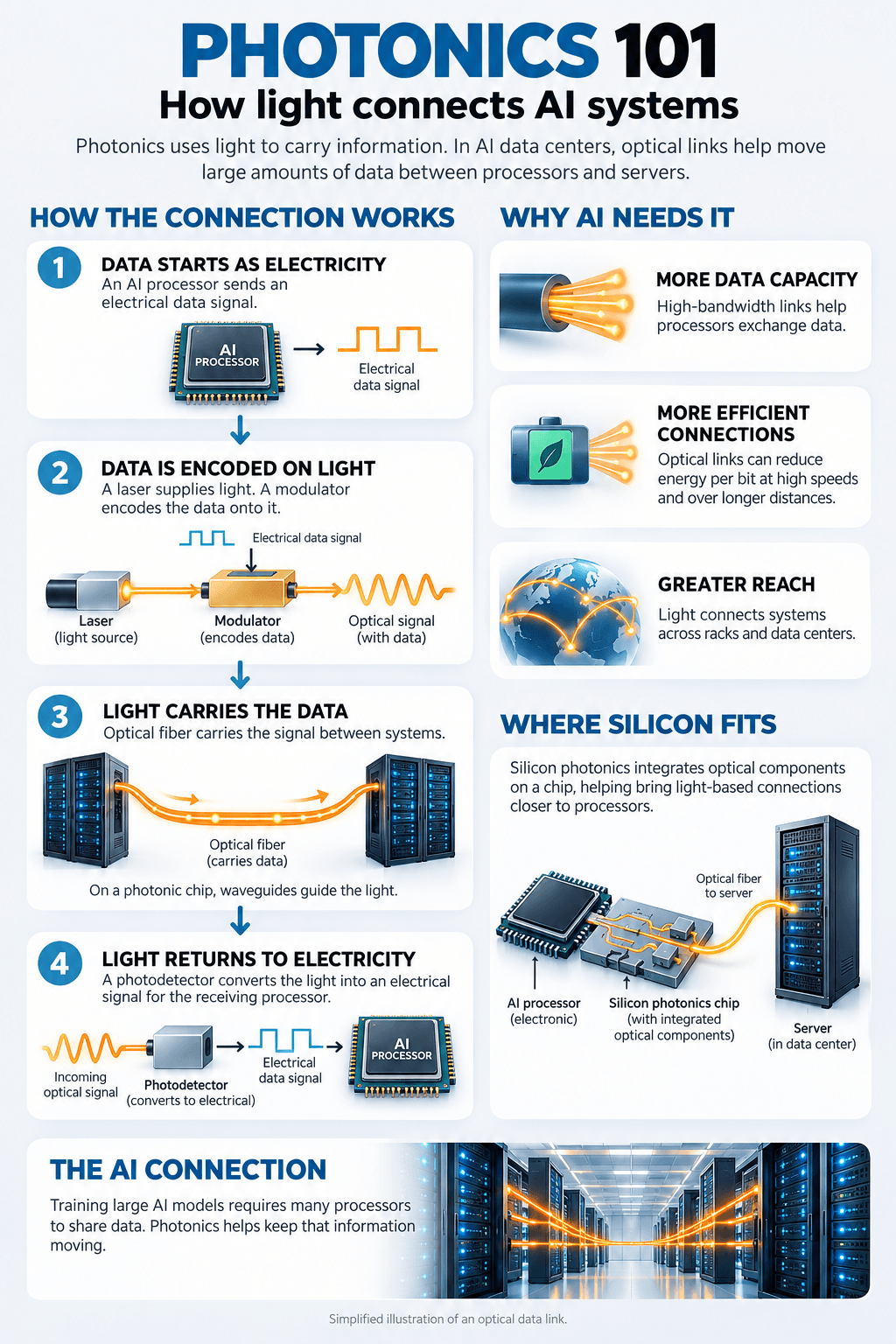
A photonic system has three basic parts:
A light source, usually a semiconductor laser, that turns electrical signals into pulses of light.
A pathway, such as optical fiber or tiny waveguides etched into a chip, that carries the light.
A detector that turns the light back into an electrical signal the computer can use.
Keep these three parts in mind. Combined in different ways, they do three jobs: moving data inside AI data centers, helping robots see, and marking materials in factories.
Job One: Moving Data, the AI story
Start with the data center, where all three parts work together on every connection. Today most of that work happens in optical transceivers, small plug-in modules at each end of a fiber. A laser in one module turns electrical signals into light, the fiber carries it across the room, and a detector in the module at the other end turns it back into electricity. As AI clusters grow, the number of these links grows with them, and each new generation needs faster lasers.
That puts the spotlight on the companies that make the light sources. Lumentum (THNQ) and Coherent (ROBO) are among the leading makers of the high-speed laser chips AI networks rely on. Lumentum's fiscal 2026 revenue rose 83% to about $3.0 billion.1 Coherent reported record fiscal 2026 revenue of $7.12 billion, and its CEO described the shift of AI data centers from copper to optical connections as a multi-year opportunity.2
A laser alone is not enough, though. At these speeds the signal picks up noise and distortion along the way, so each transceiver also contains a specialized chip that cleans it up and decodes it. Marvell (THNQ) is a leading designer of these signal-processing chips, which sit beside the laser in many of the optical modules used in AI networks. Arista Networks (THNQ) brings these connections together in switches that move data among AI servers, helping processors work as a coordinated system.
Even with those specialized chips, housing optics inside separate modules still leaves an electrical bottleneck between the module and the main processor. Overcoming that barrier requires silicon photonics, manufacturing optical circuits directly on silicon using the exact same foundries that produce computer chips. That is what makes it possible to put light right next to a processor, and it is why the world's largest contract chipmaker has become a photonics company too. Taiwan Semiconductor Manufacturing Company or TSMC (THNQ) calls its platform COUPE, short for Compact Universal Photonic Engine, which began production in 2026.3
COUPE is a foundation for co-packaged optics, or CPO. Instead of converting signals to light in a separate module at the edge of a switch, CPO places the optical components right next to the chip, inside the same package. Think of it this way: today, data has to drive across town on slow city streets just to reach the highway on-ramp. CPO builds the on-ramp at the end of the driveway. Shortening the electrical path saves power and allows far more bandwidth to leave the chip.
The companies designing those chips are the ones turning CPO into products. NVIDIA (ROBO, THNQ) and Broadcom (THNQ) both build their CPO on TSMC's COUPE platform.4 NVIDIA has begun shipping its Spectrum-X CPO switch, and Broadcom has been shipping its 51.2-terabit Bailly CPO switch.5
None of this means copper disappears overnight. For the shortest connections, such as links between chips inside a single rack, copper is often still cheaper and simpler. Credo (THNQ) shows how the industry is covering both paths: it sells chips for optical links and active electrical cables that extend how far copper can reach. Research firm TrendForce forecasts that CPO could account for as much as 35% of optical modules in AI data centers by 2030,6 which points to a long transition rather than a sudden switch.
Job Two: Sensing, the robotics story
The same building blocks that move data between AI chips also give robots their sight. A robot is only as capable as its understanding of the world around it. Whether a machine is picking packages in a warehouse, assembling electronics or steering a car through traffic, it can only act on what it perceives, and much of that perception comes from light.
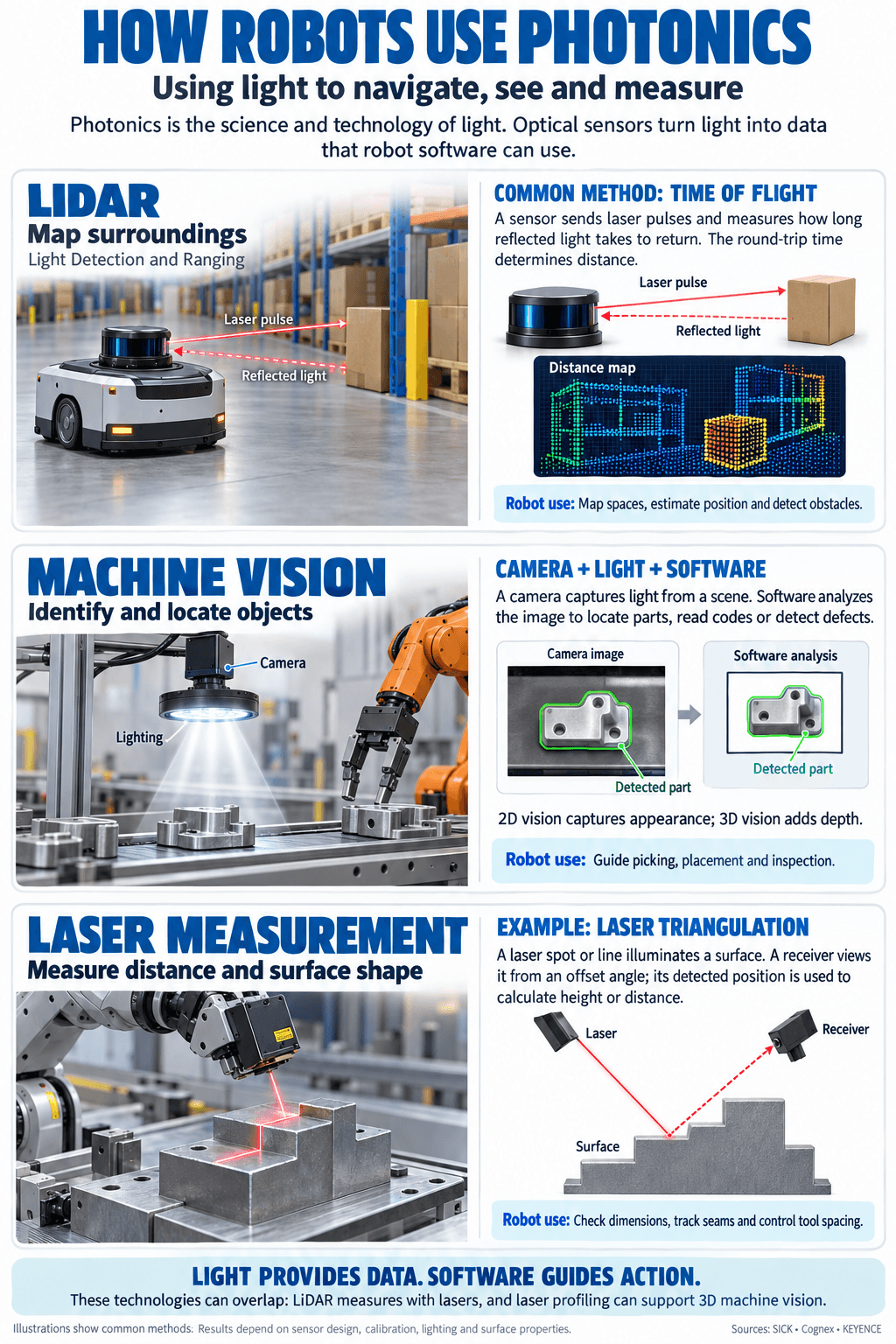
Robots rely on three main photonic tools:
Lidar works like shouting into a canyon and timing the echo to judge the distance. Instead of sound, it uses laser pulses. The laser is the light source, open air is the pathway, and a detector catches the reflection. Repeated millions of times per second, those echoes build a 3D map of the surroundings point by point.
Machine vision combines cameras, lenses and lighting with software to inspect, identify and guide. Here the camera's image sensor plays the role of the detector.
Laser measurement uses light to measure distances and shapes with precision finer than a human hair.
Each of these tools has representation in ROBO, and one of them appears in THNQ as well. On the lidar side, Ouster (ROBO) builds digital lidar sensors that give robots, vehicles and smart infrastructure a 3D view of their environment.
Machine vision is a larger and more established market. Cognex (ROBO, THNQ) and Keyence (ROBO) make vision systems and optical sensors that factories use to inspect products, read codes and guide robots, often at speeds no human inspector could match. Zebra Technologies (ROBO) brings the same technology into warehouses and stores, from the barcode scanners mentioned earlier to vision systems on production lines. Koh Young (ROBO) applies 3D optical inspection to one of electronics manufacturing's most exacting jobs: checking circuit boards for defects too small for the eye to catch.
For laser measurement, Hexagon (ROBO) uses laser trackers and scanners to measure parts and structures in three dimensions, and Renishaw (ROBO) makes laser-based systems used to calibrate machine tools and check precision parts. Both help manufacturers confirm that what they built matches the design.
As robots move out of fenced-off factory areas and into warehouses, hospitals and streets, they need richer and more reliable perception. That makes photonic sensing such an important and a core piece of the robotics story.
Job three: Making Things, the manufacturing story
In the first two jobs, light carries information. In factories, it does physical work. If you have ever used a magnifying glass to scorch a leaf with sunlight, you have seen the basic idea: concentrate enough light in one spot, and it turns into heat. A laser makes that focused energy precise and powerful enough to cut steel, weld battery cells or mark a serial number on a part without ever touching it. Here, the work comes down entirely to the light source and the technologies that guide it.
IPG Photonics (ROBO) makes fiber lasers used for cutting, welding and processing materials in industries from automotive to electronics. Its second-quarter 2026 revenue rose 11% from a year earlier, driven by 16% growth in its industrial business.7 On the guidance side, Novanta (ROBO) supplies the precision optics and laser beam-steering components that direct lasers inside manufacturing and medical equipment.
Some names from the data center story show up here too. Coherent and Lumentum both sell industrial lasers alongside their networking products, a reminder that the same laser expertise serves very different markets.
At the smallest scale, light is how the world's most advanced chips are made in the first place. This is where the AI and robotics stories meet, and where THNQ and ROBO hold companies in the same supply chain.
ASML (THNQ) builds the lithography machines that print circuit patterns onto silicon wafers using extreme ultraviolet light. Shorter wavelengths of light can draw finer details, much like painting with a finer brush, which is what lets chipmakers keep shrinking circuits. These machines are essential to producing the leading-edge chips used in AI.
Jenoptik (ROBO) supplies precision optics to semiconductor equipment makers, including for lithography and inspection, along with optics for medical and defense applications. Its order intake rose 53% in the first half of 2026, led by demand from semiconductor equipment customers.8 Underscoring that light does not just carry data inside AI systems, but helps manufacture the hardware itself.
Why now
Photonics is not new. Fiber optics has carried the internet's long-distance traffic for decades, and lasers have been on factory floors since the 1970s. What has changed is where light is being used, and how much of it is needed.
Three shifts stand out in 2026:
Light is moving closer to the chip. Optical links used to connect cities and buildings. Now they are reaching inside the server rack and, with co-packaged optics, into the chip package itself.
Demand is outrunning supply. The specialized lasers behind AI networking are hard to make. Many are built on indium phosphide, a material that, unlike silicon, can emit light efficiently but is harder and more expensive to manufacture. In May 2026, Lumentum's CEO said demand for its high-speed EML lasers was running more than 30% ahead of what the company could supply.9 Coherent says it is on track to more than double its internal indium phosphide output again by the end of 2027.10
Robots are leaving the cage. As automation spreads into less structured environments, the need for lidar, vision and laser sensing grows with it.
Taken together, these trends suggest photonics is evolving from a specialized component into a foundational technology, much as semiconductors did in earlier computing eras.
Light at the center of AI and Automation
It is easy to think of AI and robotics as separate worlds, one built on software and data centers, the other on machines and factories. Photonics connects them: the same technology moves data between AI chips, helps robots perceive their surroundings, and shapes the hardware both rely on.
For investors, that makes photonics a useful lens for understanding where value may be created as these technologies scale. It also helps explain why companies across very different industries, from laser makers and chip foundries to machine vision and lidar specialists, can share exposure to the same underlying trend.
ROBO and THNQ seek to capture that landscape from two directions. ROBO's photonics exposure leans toward lasers, sensing and precision manufacturing, through companies such as IPG Photonics, Novanta, Keyence, Hexagon and Ouster, but it also reaches into AI networking through Coherent and NVIDIA. THNQ's exposure leans toward the optical networking and chip technologies inside AI data centers, through companies such as Lumentum, Marvell, Broadcom and TSMC, and toward chipmaking through ASML. NVIDIA and Cognex appear in both. Together they reflect a simple idea: in the next phase of AI and automation, light is doing more of the work.
All holdings as of 10/20/26. Holdings subject to change. To view ROBO holdings, click here. To view THNQ holdings, click here.
Sources
Lumentum Holdings Inc., Annual Report (Form 10-K) for the Fiscal Year Ended June 27, 2026 (filed with the U.S. Securities and Exchange Commission, 2026).
Coherent Corp., "Coherent Corp. Reports Fourth Quarter and Full Year Fiscal 2026 Results," press release, August 12, 2026.
"Silicon Photonics Race Intensifies as TSMC Targets 2026 COUPE Production, Samsung Eyes 2029 CPO Turnkey," TrendForce News, April 1, 2026.
"Co-Packaged Optics Race: Strategic Approaches from NVIDIA and Broadcom," IDTechEx Research Article, 2026.
TrendForce, "NVIDIA and Broadcom Begin Volume Ramp of CPO Switches," press release, July 27, 2026.
"TSMC Targets 2H26 COUPE on Substrate; NVIDIA Could Eye Long-Term Substrate Deals Amid CPO Push," TrendForce News, May 18, 2026.
IPG Photonics Corporation, "IPG Photonics Announces Second Quarter 2026 Financial Results," press release, August 4, 2026.
Jenoptik AG, "Jenoptik Reports Significant Increase in Orders and Earnings in the First Half of 2026," press release, August 12, 2026.
"Lumentum Q3 Earnings Call Highlights," MarketBeat, May 5, 2026.
"Coherent Q4 FY 2026 Earnings: 1.6T Transceivers Ramp, CPO Revenue Approaches," Futurum Group, August 2026.

Carefully consider the Funds’ investment objectives, risk factors, charges and expenses before investing. This and additional information can be found on the Funds' full or summary prospectuses, which may be obtained at www.roboglobaletfs.com. Read the prospectus carefully before investing.
Investing involves risk, including the possible loss of principal. International investments may also involve risk from unfavorable fluctuations in currency values, differences in generally accepted accounting principles, and from economic or political instability. Emerging markets involve heightened risks related to the same factors as well as increased volatility and lower trading volume. Narrowly focused investments and investments in smaller companies typically exhibit higher volatility. There is no guarantee the funds will achieve their stated objective. ROBO and HTEC are diversified. THNQ is non-diversified.
The liquidity of the A-shares market and trading prices of A-shares could be more severely affected than the liquidity and trading prices of other markets because the Chinese government restricts the flow of capital into and out of the A-shares market. The funds may experience losses due to illiquidity of the Chinese securities markets or delay or disruption in execution or settlement of trades.
The risks associated with investments in Robotics and Automation Companies include, but are not limited to, small or limited markets for such securities, changes in business cycles, world economic growth, technological progress, rapid obsolescence, and government regulation. Robotics and Automation Companies, especially smaller, start-up companies, tend to be more volatile than securities of companies that do not rely heavily on technology. Rapid change to technologies that affect a company's products could have a material adverse effect on such company's operating results. Robotics and Automation Companies may rely on a combination of patents, copyrights, trademarks and trade secret laws to establish and protect their proprietary rights in their products and technologies. There can be no assurance that the steps taken by these companies to protect their proprietary rights will be adequate to prevent the misappropriation of their technology or that competitors will not independently develop technologies that are substantially equivalent or superior to such companies' technology.
The risks associated with Artificial Intelligence (AI) Companies include, but are not limited to, small or limited markets, changes in business cycles, world economic growth, technological progress, rapid obsolescence, and government regulation. Rapid change to technologies that affect a company’s products could have a material adverse effect on such company’s operating results. AI Companies also rely heavily on a combination of patents, copyrights, trademarks and trade secret laws to establish and protect their proprietary rights in their products and technologies. There can be no assurance that the steps taken by these companies to protect their proprietary rights will be adequate to prevent the misappropriation of their technology or that competitors will not independently develop technologies that are substantially equivalent or superior to such companies’ technology. AI Companies typically engage in significant amounts of spending on research and development, and there is no guarantee that the products or services produced by these companies will be successful.
The risks associated with Medical Technology Companies include, but are not limited to, small or limited markets for such securities, changes in business cycles, world economic growth, technological progress, rapid obsolescence, and government regulation.
Diversification may not protect against market risk.
Beginning September 2, 2020, market price returns are based on the official closing price of an ETF share or, if the official closing price isn't available, the midpoint between the national best bid and national best offer (“NBBO”) as of the time the ETF calculates current NAV per share. Prior to September 2, 2020, market price returns were based on the midpoint between the Bid and Ask price. NAVs are calculated using prices as of 4:00 PM Eastern Time. The returns shown do not represent the returns you would receive if you traded shares at other times.
The Funds are distributed by SEI Investments Distribution Co. (SIDCO) 1 Freedom Valley Drive, Oaks, PA, 19456