
Two sides of the same meter
Artificial intelligence runs on electricity, and it needs that electricity every hour of every day. The International Energy Agency estimates that data centers used about 415 terawatt-hours in 2024, roughly 1.5% of the world's electricity, and expects that figure to more than double to around 945 terawatt-hours by 2030.1 In the United States, data centers account for nearly half of expected electricity demand growth over that period.¹
That appetite has turned the largest technology companies into major new customers for nuclear power. It has also created a relationship that runs in two directions. AI companies are the buyers, signing long-term contracts that keep existing reactors running and help fund new ones. Nuclear companies are the builders, and they are increasingly using AI to design, license and operate plants faster.
The ROBO Global Artificial Intelligence ETF (THNQ) and the Range Nuclear Renaissance Index ETF (NUKZ) sit on opposite sides of that relationship. As of October 20th holdings, no company appears in both funds. Yet several of THNQ's largest technology names have signed deals with NUKZ holdings, which makes the two portfolios less like separate themes and more like two halves of the same build-out.
The buyers: AI companies are signing up for decades of power
Capital spending reveals the scale of the AI buildout. In July, Alphabet raised its 2026 capital spending guidance to $195 billion to $205 billion, up from $180 billion to $190 billion, to deliver AI capacity faster.² Analysts estimate the four largest cloud builders will spend more than $700 billion combined this year.³ Much of that money becomes servers, and every server needs power around the clock.
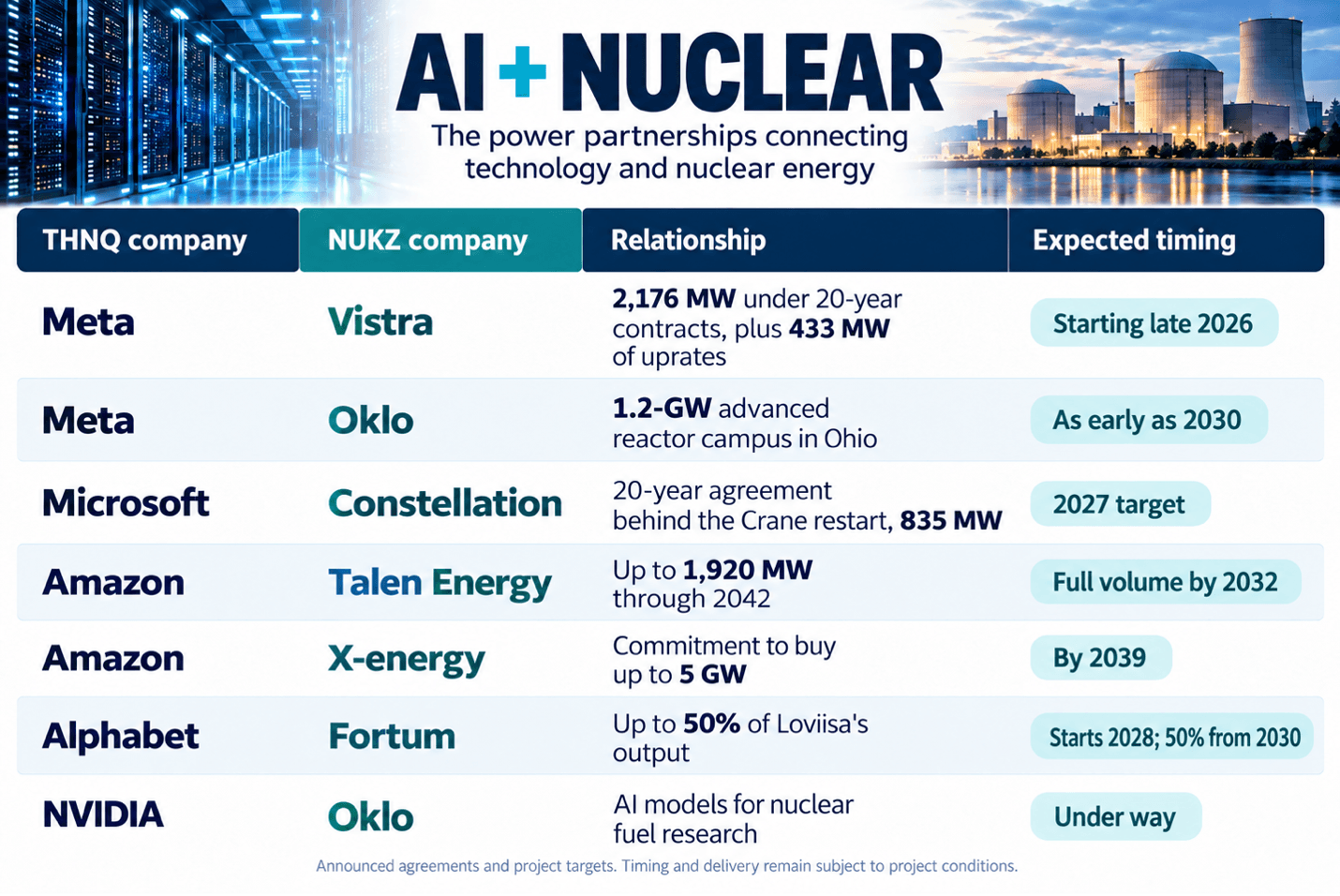
Those buyers are well represented in THNQ, and their nuclear contracts reach deep into NUKZ:
Meta (THNQ) announced agreements in January with Vistra (NUKZ), Oklo (NUKZ) and the private developer TerraPower that could total up to 6.6 gigawatts by 2035. Vistra will sell Meta 2,176 megawatts from existing plants in Ohio and Pennsylvania under 20-year contracts, plus 433 megawatts of uprates. Oklo will develop a 1.2-gigawatt campus in Pike County, Ohio, with a first phase targeted as early as 2030.⁴
Microsoft (THNQ) signed a 20-year agreement that underpins Constellation's (NUKZ) restart of the 835-megawatt Crane Clean Energy Center, formerly Three Mile Island Unit 1. Constellation is targeting a 2027 restart.⁵
Amazon (THNQ) will buy up to 1,920 megawatts from Talen Energy's (NUKZ) Susquehanna plant through 2042.⁶ It is also the anchor customer for X-energy (NUKZ), which raised $1.02 billion in its April IPO and holds Amazon's commitment to buy up to 5 gigawatts of nuclear power by 2039.⁷
Alphabet (THNQ) signed its first nuclear power agreement outside the US in September: a 22-year deal for up to half the output of Fortum's (NUKZ) Loviisa plant in Finland from 2030 through 2049.⁸
The buyers are not limited to the giants. Nebius (THNQ), an AI cloud provider that builds and runs its own data centers, now targets 5 gigawatts of contracted power by the end of 2026.⁹ That is roughly four times the size of the Oklo campus at full build.
The builders: contracts turn demand into financing
For nuclear companies, a long-term contract with a creditworthy technology company can provide the revenue certainty needed to finance projects with investment horizons spanning decades. Talen described its Amazon agreement as a long-term, steady source of revenue that gives it greater balance sheet flexibility.⁶ Fortum expects its Google deal to potentially lift its return on net assets by about 1.4 percentage points once half of Loviisa's capacity is contracted, and said the contract gives it economic certainty to extend the plant's life to 2050.¹⁰
NUKZ aims to hold the full chain those contracts set in motion. Power producers such as Constellation, Vistra, Talen and Fortum sell the electricity. Reactor developers such as Oklo, X-energy and NuScale are designing the next generation of plants. Equipment and engineering firms such as GE Vernova, BWX Technologies and Curtiss-Wright supply the hardware, and fuel companies such as Cameco, Centrus Energy and Uranium Energy supply what goes inside. Cameco is one of the fund's largest holdings as of 10/20/26.¹¹
Government funding is adding another layer of financial support to the nuclear buildout. Cameco co-owns reactor designer Westinghouse with Brookfield. On September 30, the US and South Korea announced a framework anticipating $120 billion of Korean investment to help finance Westinghouse reactors in the US.¹² That builds on a partnership worth at least $80 billion that the US government signed with Westinghouse in 2025.¹³ NUKZ holds several Korean companies that could take part, including Korea Electric Power, Samsung C&T and Doosan.
It runs both ways: AI is helping build nuclear
At the International Atomic Energy Agency's first symposium on AI and nuclear energy, Director General Rafael Grossi called the relationship a "structural alliance" and named it Atoms for Algorithms. His point was that AI is not only consuming nuclear power but also improving how nuclear plants are designed, run and kept safe.¹⁴
The biggest bottleneck in new nuclear is often paperwork rather than physics. Safety analyses and licensing applications run to thousands of pages and take years to prepare and review. That is where THNQ's technology companies are now working directly with NUKZ's reactor developers:
Licensing. Idaho National Laboratory is using a Microsoft (THNQ) solution built on Azure AI to generate the engineering and safety analysis reports that go into construction permit and operating license applications.¹⁵
Design and deployment. In July, the Department of Energy awarded $60 million over three years to the Prometheus project, which brings together 32 partners, including four national laboratories and more than 20 companies such as X-energy (NUKZ), Oklo (NUKZ) and TerraPower.¹⁶ X-energy describes the effort as led by the laboratory, NVIDIA (THNQ) and Amazon Web Services (THNQ), and is contributing $10 million of its own capital.¹⁷
Fuel research. In April, Oklo, NVIDIA and Los Alamos National Laboratory agreed to develop AI models trained on physics and chemistry to support nuclear fuel research, along with proof-of-concept work on a nuclear-powered AI factory.¹⁸
Operations. Argonne National Laboratory's PRO-AID tool builds a digital twin of plant systems and compares live sensor readings with expected behavior to spot faults early. A language model then explains the diagnosis to operators in plain English.¹⁹
None of this replaces engineers, operators or regulators. In a safety-critical industry, AI's value lies in drafting, cross-referencing and monitoring, which frees experts to spend their time on the hardest technical questions.
Timing: today's power comes from existing reactors
The deals differ sharply in when they deliver electricity, which matters for when they show up in earnings. Most of the contracted capacity already exists. Talen's Susquehanna plant and Vistra's Ohio plants are running today, and the contracts extend their lives and add output through uprates. One retired reactor, Crane, is being restarted. Only the advanced reactor projects are new construction, with first power targeted for 2030 or later.
The bigger picture: two halves of one build-out
THNQ aims to give investors exposure to the demand side of this story: the cloud builders, chipmakers and AI platforms whose growth requires firm, continuous, clean power. NUKZ aims to give exposure to the supply side: the fuel suppliers, reactor developers, equipment makers and power producers that can deliver it. Signed agreements are already bringing these two sides of the story together.
Explore the AI opportunity with THNQ →
Explore the nuclear power behind it with NUKZ →
Holdings subject to change. All holdings as of 10/20/26. To view THNQ holdings, click here.>> To view NUKZ holdings, click here.>>
Sources:
International Energy Agency, Energy and AI (Paris: IEA, 2025), executive summary.
"AI Infrastructure Demand Pushes Alphabet's 2026 Capex Guidance to US$205 Billion," W.Media, July 23, 2026.
"Alphabet Capex Hike Fuels AI Spending Jitters," InsiderFinance, July 23, 2026.
Aman Gupta, "Meta Lines Up Up to 6.6 GW of Nuclear Power with Vistra, TerraPower and Oklo for Ohio AI Buildout," TechInformed, January 13, 2026.
"Constellation Seeks FERC Help with Crane Restart," Nuclear News (American Nuclear Society), April 3, 2026.
Talen Energy, "Talen Energy Expands Nuclear Energy Relationship with Amazon," press release, June 11, 2025.
"Amazon-Backed Nuclear Startup X-Energy Raises $1.02 Billion in IPO," The Next Web, April 24, 2026.
"Google Signs Nuclear PPA with Fortum in Loviisa, Finland," DatacenterDynamics, September 2026.
"Nebius Group Q2 Earnings Call Highlights," MarketBeat, August 12, 2026.
Fortum, "Inside Information: Fortum and Google Partner to Drive Sustainable Growth for Finland – Sign Nuclear Power Purchase Agreement," stock exchange release, September 9, 2026.
ROBO Global Artificial Intelligence ETF, fund holdings as of October 2, 2026; Range Nuclear Renaissance Index ETF, fund holdings as of October 6, 2026.
Cameco Corporation, "Cameco Acknowledges United States and Republic of Korea Announcement of Framework for the Deployment of Nuclear Power," news release, September 30, 2026.
"Japan, US Aim to Add Nuclear Power Project to $550 Billion Investment Package, Sources Say," Reuters, March 4, 2026.
"IAEA Hosts First AI Nuclear Symposium," Nuclear Engineering International, December 2025.
Idaho National Laboratory, "Idaho National Laboratory Collaborates with Microsoft to Streamline Nuclear Licensing," news release, July 16, 2025.
Idaho National Laboratory, "Genesis Mission Funds AI Innovation to Speed Up Safe, Affordable Nuclear Energy," news release, July 22, 2026.
X-energy, "X-energy Joins Project Prometheus for AI-Accelerated Advanced Nuclear Deployment," press release, July 22, 2026.
"Oklo Partners with Nvidia, Los Alamos on AI-Driven Advanced Nuclear Infrastructure Development," DatacenterDynamics, April 2026.
Argonne National Laboratory, "Argonne Helps Nuclear Industry Embrace AI to Speed Up Licensing and Reduce Delays," Business Wire, February 4, 2026; Argonne National Laboratory, "PRO-AID," accessed October 6, 2026.
THNQ’s Disclosures:
Carefully consider the Funds’ investment objectives, risk factors, charges and expenses before investing. This and additional information can be found on the Funds' full or summary prospectuses, which may be obtained at www.roboglobaletfs.com. Read the prospectus carefully before investing.
Investing involves risk, including the possible loss of principal. International investments may also involve risk from unfavorable fluctuations in currency values, differences in generally accepted accounting principles, and from economic or political instability. Emerging markets involve heightened risks related to the same factors as well as increased volatility and lower trading volume. Narrowly focused investments and investments in smaller companies typically exhibit higher volatility. There is no guarantee the funds will achieve their stated objective. THNQ is non-diversified.
The liquidity of the A-shares market and trading prices of A-shares could be more severely affected than the liquidity and trading prices of other markets because the Chinese government restricts the flow of capital into and out of the A-shares market. The funds may experience losses due to illiquidity of the Chinese securities markets or delay or disruption in execution or settlement of trades.
The risks associated with Artificial Intelligence (AI) Companies include, but are not limited to, small or limited markets, changes in business cycles, world economic growth, technological progress, rapid obsolescence, and government regulation. Rapid change to technologies that affect a company’s products could have a material adverse effect on such company’s operating results. AI Companies also rely heavily on a combination of patents, copyrights, trademarks and trade secret laws to establish and protect their proprietary rights in their products and technologies. There can be no assurance that the steps taken by these companies to protect their proprietary rights will be adequate to prevent the misappropriation of their technology or that competitors will not independently develop technologies that are substantially equivalent or superior to such companies’ technology. AI Companies typically engage in significant amounts of spending on research and development, and there is no guarantee that the products or services produced by these companies will be successful.
Beginning September 2, 2020, market price returns are based on the official closing price of an ETF share or, if the official closing price isn't available, the midpoint between the national best bid and national best offer (“NBBO”) as of the time the ETF calculates current NAV per share. Prior to September 2, 2020, market price returns were based on the midpoint between the Bid and Ask price. NAVs are calculated using prices as of 4:00 PM Eastern Time. The returns shown do not represent the returns you would receive if you traded shares at other times.
The Funds are distributed by SEI Investments Distribution Co. (SIDCO) 1 Freedom Valley Drive, Oaks, PA, 19456
NUKZ Disclosures:
Investing involves risk, including possible loss of principal. There is no guarantee the Funds will achieve their stated investment objectives. Carefully consider the investment objectives, risks, charges, and expenses. This and other important information can be found in the Funds' prospectuses, which should be read carefully before investing and can be obtained by visiting www.rangeetfs.com/investor-materials, or by calling 1-800-617-0004.
Investments in the energy industry are subject to significant volatility due to changes in commodity prices. Additional risks include changes in exchange rates, government regulation, world events, economic and political conditions in the countries where energy companies are located or do business, and risks for environmental damage claims.
The Fund is non-diversified. Its concentration in an industry or sector can increase the impact of, and potential losses associated with, the risks from investing in those industries/sectors.
Nuclear companies may be subject to substantial government regulation and contractual fixed pricing, which may increase the cost of doing business and limit the earnings of these companies. A significant portion of revenues of nuclear companies depends on a relatively small number of customers, including governmental entities and utilities. As a result, governmental budget constraints may have a material adverse effect on the stock prices of companies in this sub-industry.
International investments may involve risk of capital loss from unfavorable fluctuation in currency values, from differences in generally accepted accounting principles or from social, economic or political instability in other nations. Emerging markets involve heightened risks related to the same factors as well as increased volatility and lower trading volume. Investments in smaller companies typically exhibit higher volatility.
The Fund may invest in securities denominated in foreign currencies. Because the Fund's NAV is determined in U.S. dollars, the Fund's NAV could decline if currencies of the underlying securities depreciate against the U.S. dollar or if there are delays or limits on repatriation of such currencies. Currency exchange rates can be very volatile and can change quickly and unpredictably.
Exchange Traded Concepts, LLC serves as the investment advisor of the funds. NUKZ and COAL ETFs are distributed by SEI Investments Distribution Co. (SIDCO, 1 Freedom Valley Drive, Oaks, PA 19456), which is not affiliated with Exchange Traded Concepts, LLC or any of its affiliates.

Carefully consider the Funds’ investment objectives, risk factors, charges and expenses before investing. This and additional information can be found on the Funds' full or summary prospectuses, which may be obtained at www.roboglobaletfs.com. Read the prospectus carefully before investing.
Investing involves risk, including the possible loss of principal. International investments may also involve risk from unfavorable fluctuations in currency values, differences in generally accepted accounting principles, and from economic or political instability. Emerging markets involve heightened risks related to the same factors as well as increased volatility and lower trading volume. Narrowly focused investments and investments in smaller companies typically exhibit higher volatility. There is no guarantee the funds will achieve their stated objective. ROBO and HTEC are diversified. THNQ is non-diversified.
The liquidity of the A-shares market and trading prices of A-shares could be more severely affected than the liquidity and trading prices of other markets because the Chinese government restricts the flow of capital into and out of the A-shares market. The funds may experience losses due to illiquidity of the Chinese securities markets or delay or disruption in execution or settlement of trades.
The risks associated with investments in Robotics and Automation Companies include, but are not limited to, small or limited markets for such securities, changes in business cycles, world economic growth, technological progress, rapid obsolescence, and government regulation. Robotics and Automation Companies, especially smaller, start-up companies, tend to be more volatile than securities of companies that do not rely heavily on technology. Rapid change to technologies that affect a company's products could have a material adverse effect on such company's operating results. Robotics and Automation Companies may rely on a combination of patents, copyrights, trademarks and trade secret laws to establish and protect their proprietary rights in their products and technologies. There can be no assurance that the steps taken by these companies to protect their proprietary rights will be adequate to prevent the misappropriation of their technology or that competitors will not independently develop technologies that are substantially equivalent or superior to such companies' technology.
The risks associated with Artificial Intelligence (AI) Companies include, but are not limited to, small or limited markets, changes in business cycles, world economic growth, technological progress, rapid obsolescence, and government regulation. Rapid change to technologies that affect a company’s products could have a material adverse effect on such company’s operating results. AI Companies also rely heavily on a combination of patents, copyrights, trademarks and trade secret laws to establish and protect their proprietary rights in their products and technologies. There can be no assurance that the steps taken by these companies to protect their proprietary rights will be adequate to prevent the misappropriation of their technology or that competitors will not independently develop technologies that are substantially equivalent or superior to such companies’ technology. AI Companies typically engage in significant amounts of spending on research and development, and there is no guarantee that the products or services produced by these companies will be successful.
The risks associated with Medical Technology Companies include, but are not limited to, small or limited markets for such securities, changes in business cycles, world economic growth, technological progress, rapid obsolescence, and government regulation.
Diversification may not protect against market risk.
Beginning September 2, 2020, market price returns are based on the official closing price of an ETF share or, if the official closing price isn't available, the midpoint between the national best bid and national best offer (“NBBO”) as of the time the ETF calculates current NAV per share. Prior to September 2, 2020, market price returns were based on the midpoint between the Bid and Ask price. NAVs are calculated using prices as of 4:00 PM Eastern Time. The returns shown do not represent the returns you would receive if you traded shares at other times.
The Funds are distributed by SEI Investments Distribution Co. (SIDCO) 1 Freedom Valley Drive, Oaks, PA, 19456