
Women’s health is entering a new era of investment, innovation and clinical attention. Long concentrated around reproductive and maternal care, the category is expanding across diagnostics, genetic testing, cancer screening, hormonal health, menopause, imaging and medical devices, creating a broader healthcare market centered on the needs of women across every stage of life.
The economic stakes may be significant. Research published jointly by the World Economic Forum and the McKinsey Health Institute found that women spend roughly 25% more of their lives in poor health than men and estimated that narrowing this health gap could add as much as $1 trillion annually to global GDP by 2040.¹ At the same time, roughly 1% of healthcare research and innovation investment has historically been directed toward conditions specific to women beyond oncology.¹
That combination of unmet need and historical underinvestment is increasingly attracting attention from researchers, healthcare providers, policymakers and capital markets. It is also creating opportunities for the companies developing the technologies required to diagnose, monitor and treat conditions across the female lifespan.
Market forecasts reflect that momentum. Industry estimates project the broader women’s health technology market could reach hundreds of billions of dollars over the coming decade, with areas including diagnostics, reproductive genetics and hormone-monitoring technologies expected to participate in that growth.²˒³ Menopause care is also emerging as a distinct area of innovation following the FDA’s 2023 approval of the first non-hormonal treatment for vasomotor symptoms, helping bring greater clinical and commercial attention to a stage of life affecting millions of women.²
The ROBO Global Healthcare Technology & Innovation ETF (HTEC) seeks to provide exposure to several established healthcare technology companies already participating in this evolution. Across reproductive genetics, molecular diagnostics, breast imaging, hormonal testing and pelvic health, HTEC holdings (as of 9/10/26) illustrate how women’s health is becoming embedded across multiple segments of the healthcare technology ecosystem.
Natera: Reproductive Genetics Across the Continuum of Care
Women’s health represents one of three core pillars of Natera’s business, alongside oncology and organ health. Its Panorama test is the most widely ordered non-invasive prenatal screen in the United States, using a proprietary single-nucleotide-polymorphism approach to distinguish fetal from maternal DNA through a maternal blood draw.⁴
Natera has continued to broaden the capabilities of this platform. In early 2026, the company expanded its Fetal Focus test from a smaller group of inherited conditions to 21 genetic diseases, including cases in which paternal DNA is unavailable for comparison (a common limitation in real-world prenatal care).⁴ Beyond pregnancy, Natera’s Empower test applies the company’s genetic-testing capabilities to hereditary cancer risk, extending its technology across reproductive health and oncology.
The result is a platform positioned at two important healthcare trends: the growing use of precision diagnostics and the increasing prioritization of women’s health throughout the continuum of care.
Roche: Expanding Access Across the Female Lifespan
Roche has developed a broad women’s health diagnostics portfolio spanning cervical, breast and ovarian cancer detection, fertility assessment, prenatal testing and bone health.⁵
One of its most notable recent advances addresses a persistent challenge in women’s healthcare: access to screening. In 2024, Roche received FDA approval for one of the first HPV self-collection solutions available in the United States, enabling women to collect their own samples in a healthcare setting rather than undergoing a traditional examination.⁶ With more than half of new cervical cancer cases occurring among women who are under-screened or have never been screened, expanding access could have meaningful implications for earlier detection.
Roche’s Elecsys AMH assay further extends the company’s presence into hormonal health, helping assess ovarian reserve and the transition toward menopause. Together, these technologies demonstrate how diagnostics can expand the reach of women’s healthcare while supporting more individualized clinical decision-making.
QIAGEN: Broadening Global Access to Cervical Cancer Screening
QIAGEN brings another dimension to the women’s health opportunity through its dedicated Sexual and Reproductive Health portfolio, with strength in HPV detection and cervical cancer screening.⁷
Its careHPV test was designed specifically for low-resource settings and has received World Health Organization prequalification, helping expand cervical cancer screening in regions where sophisticated laboratory infrastructure may be limited.
The company has also extended its molecular diagnostics capabilities into precision oncology. Its therascreen platform supports companion diagnostics for HPV-related cancers, while its therascreen PIK3CA test helps inform treatment decisions in advanced breast cancer.
QIAGEN’s portfolio illustrates how advances in women’s health are linking earlier screening and prevention with more precise, targeted approaches to treatment.
Siemens Healthineers: Bringing Greater Clinical Focus to Menopause
As menopause receives greater clinical, consumer and investment attention, Siemens Healthineers has developed diagnostic capabilities specifically addressing hormonal aging.
The company markets an assay panel for the evaluation of menopause covering AMH, DHEAS, estradiol, FSH, LH, SHBG, testosterone and TSH8, providing clinicians with tools to evaluate the hormonal changes associated with this stage of life.
Its women’s health capabilities also extend into imaging. Siemens Healthineers operates a dedicated breast-care portfolio that combines mammography and ultrasound technologies, including solutions designed to improve detection in women with dense breast tissue.
Together, these offerings position the company across two areas receiving increasing attention within women’s health: midlife hormonal care and more advanced breast cancer screening.
GE HealthCare: Advancing the Next Generation of Breast Imaging
GE HealthCare has made women’s health a formally defined part of its imaging business, with Women’s Health representing one of six named product lines within its Imaging segment alongside categories such as Computed Tomography and Magnetic Resonance.⁹ That organizational structure reflects the growing importance of women-specific imaging technologies within the broader medical technology market.
The company continues to invest in next-generation mammography. In late 2025, GE HealthCare received FDA authorization for Pristina Recon DL, an AI-based deep-learning technology designed to improve 3D mammography image reconstruction clarity without increasing radiation exposure.⁹
The technology also illustrates a broader convergence occurring within healthcare: artificial intelligence is being incorporated into established diagnostic platforms, potentially improving image quality, workflow and clinical decision-making in areas such as breast cancer screening.
Abbott: Extending Diagnostics Into the Menopause Transition
Abbott’s diagnostics capabilities span pregnancy, fertility, cervical cancer screening and, increasingly, hormonal aging.
The company has published clinical guidance describing how FSH and estradiol testing can support the assessment of menopause and perimenopause when evaluated alongside a patient’s symptoms and medical history.¹⁰ This expansion reflects growing clinical recognition of menopause as an important healthcare category requiring more dedicated diagnostic tools and care pathways.
Abbott has also applied its molecular diagnostics capabilities to cervical cancer screening, offering an HPV self-collection option through its Alinity platform. Alongside similar advances from Roche and QIAGEN, these technologies point toward an industry-wide effort to make screening more accessible and convenient.
DiaSorin: Supporting Fertility and Reproductive Aging Through Hormonal Diagnostics
DiaSorin’s LIAISON platform includes a dedicated fertility diagnostics menu covering estradiol, FSH, LH and progesterone, supporting fertility treatment monitoring as well as the hormonal assessment associated with reproductive aging.¹¹
While smaller in scale within this market than some of HTEC’s larger diagnostics holdings, DiaSorin illustrates the growing importance of hormone immunoassay testing within women’s healthcare.
The presence of several HTEC companies in this category also signals a broader industry development: hormonal health is becoming a more established component of the diagnostics market as clinical attention expands from fertility into perimenopause, menopause and healthy aging.
Boston Scientific: Addressing an Important Midlife Health Need
Boston Scientific adds medical devices and pelvic health to HTEC’s women’s health exposure through a dedicated franchise addressing conditions including stress urinary incontinence and pelvic organ prolapse; conditions whose prevalence increases as women age and pelvic floor tissues change around menopause.¹²
Its portfolio includes the Bulkamid urethral bulking system, Solyx single-incision sling and Upsylon Y-mesh for prolapse repair, supported by continued post-market clinical research.
Pelvic health has historically received less public attention than areas such as fertility or breast cancer, despite its impact on quality of life for millions of women. Greater awareness of menopause and healthy aging could bring additional attention to these conditions and the technologies designed to treat them.
A Broader Women's Health Ecosystem Takes Shape
Women’s health is emerging as a distinct healthcare innovation market being supported by greater research attention, expanding clinical infrastructure, improving diagnostic capabilities and growing recognition of the economic consequences of unmet health needs.
For investors, the opportunity may extend across a broad technology ecosystem. Genetic testing is transforming prenatal and hereditary-risk assessment. Molecular diagnostics are expanding access to cervical cancer screening. AI is improving breast imaging. Hormonal testing is supporting fertility and menopause care. Medical devices are addressing pelvic health and other conditions associated with aging.
HTEC aims to provide exposure to established companies participating across many of these areas. Natera, Roche, QIAGEN, Siemens Healthineers, GE HealthCare, Abbott, DiaSorin and Boston Scientific each approach women’s health from a different part of the healthcare technology value chain, creating exposure across diagnostics, imaging, genetics and medical devices.
Women are half the global population and, by McKinsey's count, have historically received roughly 1% of healthcare research investment for conditions specific to them beyond oncology. That imbalance is beginning to narrow as women’s health attracts greater clinical attention, research funding and investor interest, bringing new capital and innovation to areas of longstanding unmet need. Growing demand for better diagnostics, earlier detection, more personalized care and technologies designed around female physiology could support a meaningful new cycle of healthcare innovation.
For HTEC, many of the companies building that infrastructure are already part of the portfolio.
Holdings subject to change. Click here to view holdings.
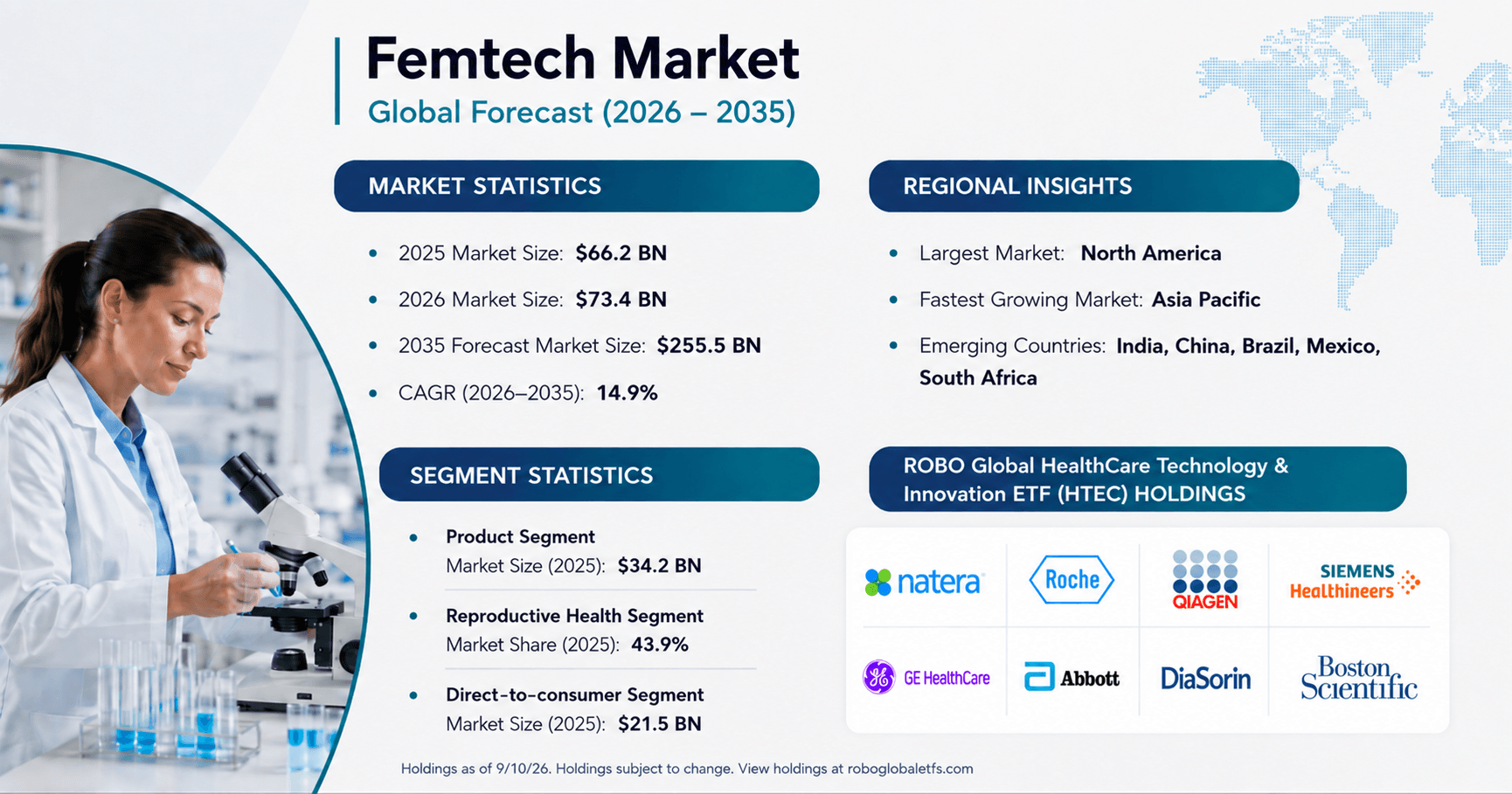
Source: Global Market Insights, “Femtech Market Size & Share, Statistics Report 2026–2035,” April 2026.
Sources
1. World Economic Forum and McKinsey Health Institute. "Closing the Women's Health Gap: A $1 Trillion Opportunity to Improve Lives and Economies." January 2024.
2. Fortune Business Insights. "Femtech Market Size, Share, Trends & Value." 2026.
3. Global Market Insights. "Femtech Market Size & Share, Statistics Report 2026-2035." April 1, 2026.
4. Natera, Inc. Form 10-Q, Quarterly Report, 2026. U.S. Securities and Exchange Commission.
5. Roche. "Women's Health." Roche Diagnostics. Accessed August 2026.
6. Roche. "Roche Announces FDA Approval of One of the First HPV Self-Collection Solutions in the U.S." Roche Media Release, May 15, 2024.
7. QIAGEN. "Standing Together Against Cervical Cancer." QIAGEN Applications. Accessed August 2026.
8.Siemens Healthineers. "Menopause and Andropause." Siemens Healthineers Laboratory Diagnostics. Accessed August 2026.
9. GE HealthCare Technologies Inc. Form ARS, Annual Report to Shareholders, 2023. U.S. Securities and Exchange Commission.
10. Abbott. "What Do FSH and Oestrogen Blood Test Results Mean?" Abbott Medicines, June 11, 2026.
11. DiaSorin. "Fertility Diagnostics Solutions." DiaSorin Immunodiagnostics. Accessed August 2026.
12. Boston Scientific. "Women's Health." Boston Scientific Patient Resources. Accessed August 2026.

Carefully consider the Funds’ investment objectives, risk factors, charges and expenses before investing. This and additional information can be found on the Funds' full or summary prospectuses, which may be obtained at www.roboglobaletfs.com. Read the prospectus carefully before investing.
Investing involves risk, including the possible loss of principal. International investments may also involve risk from unfavorable fluctuations in currency values, differences in generally accepted accounting principles, and from economic or political instability. Emerging markets involve heightened risks related to the same factors as well as increased volatility and lower trading volume. Narrowly focused investments and investments in smaller companies typically exhibit higher volatility. There is no guarantee the funds will achieve their stated objective. ROBO and HTEC are diversified. THNQ is non-diversified.
The liquidity of the A-shares market and trading prices of A-shares could be more severely affected than the liquidity and trading prices of other markets because the Chinese government restricts the flow of capital into and out of the A-shares market. The funds may experience losses due to illiquidity of the Chinese securities markets or delay or disruption in execution or settlement of trades.
The risks associated with investments in Robotics and Automation Companies include, but are not limited to, small or limited markets for such securities, changes in business cycles, world economic growth, technological progress, rapid obsolescence, and government regulation. Robotics and Automation Companies, especially smaller, start-up companies, tend to be more volatile than securities of companies that do not rely heavily on technology. Rapid change to technologies that affect a company's products could have a material adverse effect on such company's operating results. Robotics and Automation Companies may rely on a combination of patents, copyrights, trademarks and trade secret laws to establish and protect their proprietary rights in their products and technologies. There can be no assurance that the steps taken by these companies to protect their proprietary rights will be adequate to prevent the misappropriation of their technology or that competitors will not independently develop technologies that are substantially equivalent or superior to such companies' technology.
The risks associated with Artificial Intelligence (AI) Companies include, but are not limited to, small or limited markets, changes in business cycles, world economic growth, technological progress, rapid obsolescence, and government regulation. Rapid change to technologies that affect a company’s products could have a material adverse effect on such company’s operating results. AI Companies also rely heavily on a combination of patents, copyrights, trademarks and trade secret laws to establish and protect their proprietary rights in their products and technologies. There can be no assurance that the steps taken by these companies to protect their proprietary rights will be adequate to prevent the misappropriation of their technology or that competitors will not independently develop technologies that are substantially equivalent or superior to such companies’ technology. AI Companies typically engage in significant amounts of spending on research and development, and there is no guarantee that the products or services produced by these companies will be successful.
The risks associated with Medical Technology Companies include, but are not limited to, small or limited markets for such securities, changes in business cycles, world economic growth, technological progress, rapid obsolescence, and government regulation.
Diversification may not protect against market risk.
Beginning September 2, 2020, market price returns are based on the official closing price of an ETF share or, if the official closing price isn't available, the midpoint between the national best bid and national best offer (“NBBO”) as of the time the ETF calculates current NAV per share. Prior to September 2, 2020, market price returns were based on the midpoint between the Bid and Ask price. NAVs are calculated using prices as of 4:00 PM Eastern Time. The returns shown do not represent the returns you would receive if you traded shares at other times.
The Funds are distributed by SEI Investments Distribution Co. (SIDCO) 1 Freedom Valley Drive, Oaks, PA, 19456